
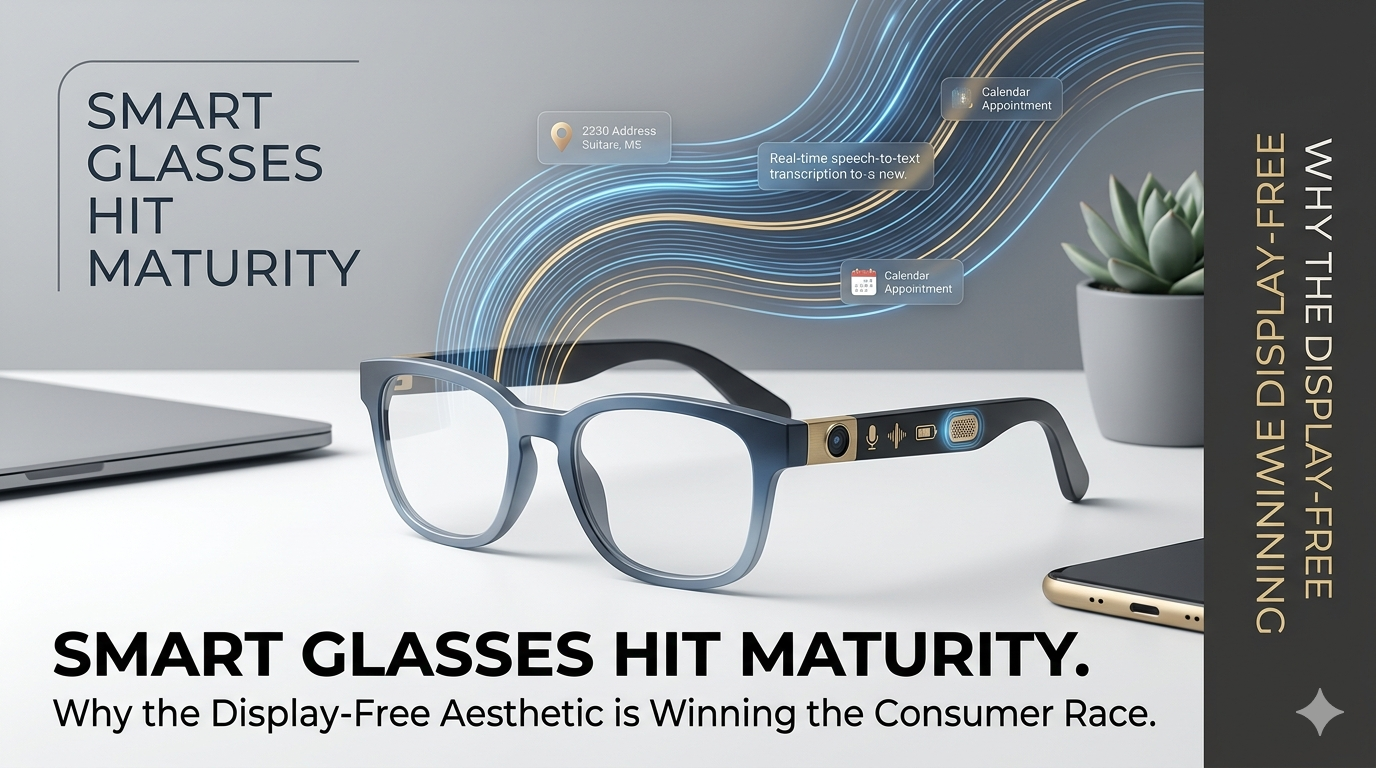
Smart Glasses Hit Maturity: Why the Display-Free Aesthetic is Winning the Consumer Race
For nearly a decade, Silicon Valley operated under a singular, unshakeable assumption: the logical evolution of personal computing was a heads-up display strapped to your face. Tech giants poured billions into augmented reality (AR) and mixed-reality (MR) pass-through lenses, envisioning a near future where human beings walked through the world navigating floating notification panels, virtual desktop arrays, and digital widgets anchored to the physical environment.
Yet, as we move through 2026, the marketplace has delivered a resounding counter-verdict. Consumers do not want more screens; they want less friction. The breakthrough consumer technology hit of recent quarters isn’t the heavy, ultra-dense spatial computing headset that isolates the user from their surroundings. Instead, a screenless counter-revolution has taken hold. Unassumingly normal, entirely display-free smart glasses have quietly captured the market, proving that the most sophisticated interface is the one you cannot see.
1. The Social Friction of Augmented Reality
To understand why screenless smart glasses are outpacing their display-laden counterparts, one must look closely at consumer psychology and social dynamics. Early iterations of AR eyewear suffered from a fundamental design flaw: they forced an explicit choice between digital immersion and human connection.
Wearing a device that covers your eyes, blocks your natural gaze, or projects a visible, flickering glow onto a lens creates an immediate barrier between you and the people around you. It introduces severe social friction. In a casual cafe conversation, a professional team meeting, or a walk through a neighborhood, a display-bound headset signals distraction. It implies that the wearer is mentally elsewhere, parsing a digital overlay instead of engaging with the immediate environment.
Display-free smart glasses discard this baggage entirely. Crafted from lightweight metals and classic optical acetates, they are visually indistinguishable from premium everyday prescription eyewear or sunglasses. Weighing under 50 grams, they lack the bulk, exterior nose-heavy weight distribution, and conspicuous aesthetic of display hardware. By prioritizing looking natural and feeling human first, these devices cross the critical threshold from geeky novelty to an ordinary, friction-free daily accessory.
2. The Sensory Shift: Audio and Computer Vision Over Displays
If you remove the screen, how do you interact with the digital world? The answer lies in the massive convergence of two highly optimized technical domains: low-latency, directional open-ear audio and multimodal real-time computer vision.
[Real-World Environment] ➔ [Ultra-Compact Camera Lens] ➔ [Edge/Cloud AI Inundation] ➔ [Directional Open-Ear Audio Output]
Instead of pulling a user’s focus away from the world via a localized visual notification, interactions on modern smart glasses shift entirely to contextual audio feedback and directional microphones. Users interact with fluid, real-time voice assistants that possess an acute sense of conversational continuity and local environmental awareness.
Crucially, the heavy lifting is handled by ultra-compact, low-power camera sensors embedded in the frame. These sensors don’t stream video to a screen in front of your eyes; they act as the digital eyes for your localized AI assistant. When a user double-taps the frame or speaks a conversational prompt—“What am I looking at right now?”—the assistant instantly processes the visual horizon:
-
It translates a foreign-language menu on a table and reads the options aloud into the user’s ear.
-
It looks under the hood of a car, identifies a specific automotive component or transmission layout, and gives step-by-step mechanical guidance.
-
It notes a historical landmark during an afternoon walk, offering a brief, contextual story without forcing the user to fish a smartphone out of their pocket.
By swapping a visual display for high-fidelity audio synthesis, the glasses remain an invisible, ambient layer of assistance rather than an aggressive digital distraction.
3. The Engineering Triumphs of Ditching Micro-LEDs
The decision to completely omit a heads-up display isn’t just an aesthetic or psychological choice; it is an elegant solution to the complex engineering bottlenecks that have plagued facial wearables for a generation.
Shattering the Thermal Ceiling
Driving high-refresh-rate micro-LED or micro-OLED displays requires an immense amount of processing power. When you process spatial graphics directly on a spectacle frame, the components generate substantial heat. No consumer wants a wearable that makes their temples or the bridge of their nose feel uncomfortably hot after twenty minutes of active use. Removing the display removes the thermal ceiling, allowing the device to run perfectly cool against the skin.
Overcoming the Battery and Mass Bottleneck
In spatial computing hardware, a significant portion of the device’s physical volume and total mass is dedicated to housing the heavy batteries required to keep bright screens running. To achieve all-day usage, these setups often require external, dangling battery packs wired to a pocket. By shedding the display layer, power consumption drops exponentially. Ultra-efficient audio chips and specialized image-capture processors allow smart glasses to easily cruise through a full day of mixed, contextual use on a single charge—all while utilizing a tiny battery cell neatly integrated inside a slim, lightweight arm.
Disrupting the Cost Curve
Manufacturing advanced waveguides and transparent optical displays with zero alignment defects is an incredibly expensive, low-yield process. It forces premium AR headsets into pricing brackets that alienate the mass consumer market. Display-free smart glasses skip this supply-chain bottleneck entirely. They leverage standard optical manufacturing lines, drastically reducing retail price points and making high-utility technology highly accessible.
4. Contextual, Not Immersive: The New Philosophy of Wearables
The massive adoption curve of screenless glasses represents a profound philosophical correction for consumer electronics designers. For years, the prevailing industry narrative was centered on immersion—building software and hardware architectures designed to pull human consciousness deeper into virtual simulations and artificial realities.
The maturity of display-free smart glasses proves that the true value of wearable technology lies in contextual augmentation. The goal shouldn’t be to overlay a digital simulation over reality, but to keep the user firmly anchored in the physical world while gently, invisibly sharpening their awareness.
When technology moves out of your direct line of sight and integrates seamlessly into the tools you already wear, it ceases to feel like a computer. It becomes an extension of yourself. The smart glasses market didn’t hit maturity because tech companies finally figured out how to cram a beautiful screen onto a pair of glasses; it hit maturity the moment they realized the screen was entirely beside the point.
editor's pick
latest video

news via inbox
Nulla turp dis cursus. Integer liberos euismod pretium faucibua