
Coding 2.0: Managing the Rise of the Self-Healing Codebase
For decades, a software engineer’s enterprise value was heavily tied to syntax proficiency. Success meant knowing the hyper-specific quirks of a framework, manually chasing down memory leaks through endless log files, and writing thousands of lines of boilerplate code.
By 2026, the proliferation of context-aware terminal agents, repository-wide AI co-pilots, and automated reasoning LLMs has completely commoditized syntax generation. If you can clearly articulate systemic intent, the machine can generate the code.
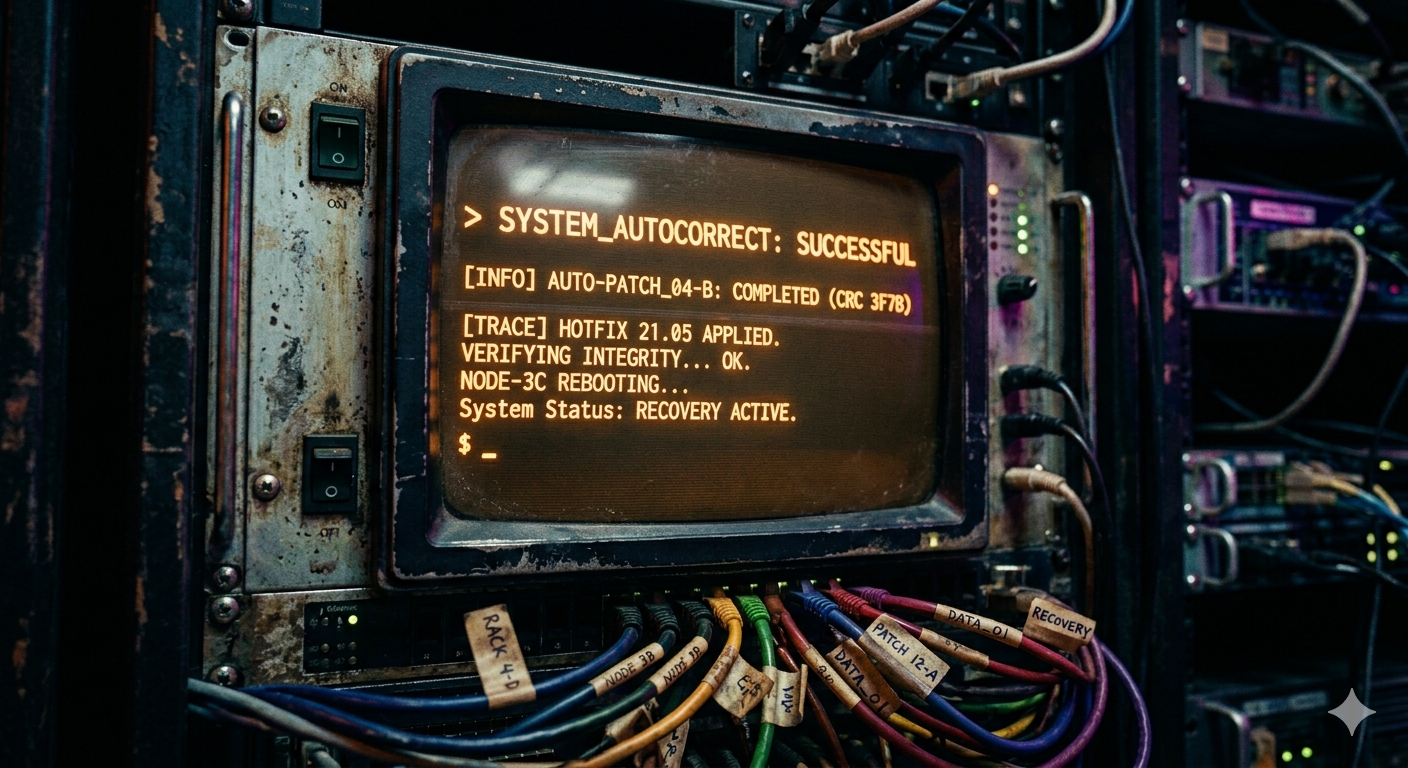
Because of this, software development is undergoing its most profound shift since the invention of the high-level compiler: the transition from assisted coding to autonomous orchestration. The frontier of this shift is the emergence of the self-healing codebase—production environments designed to monitor their own errors, trace root causes across complex distributed architectures, write their own regression tests, and open fully realized patches before a human developer can even pull up an on-call dashboard.
1. Anatomy of a Self-Healing Pipeline
A self-healing repository does not rely on simple, hard-coded conditional scripts. It combines modern observability telemetry with continuous, agentic reasoning loops. In a typical 2026 deployment, the pipeline executes in four distinct phases:
Phase 1: The Telemetry Trigger
The loop begins when production observability tools flag an anomaly—such as a sudden spike in unhandled exceptions, a sequence of database transaction timeouts, or a severe API response degradation. Instead of just firing an alert to an engineer’s phone, the monitoring framework packages the raw stack trace, active runtime metrics, and recent deployment metadata into a structured contextual payload.
Phase 2: Autonomous Replication
Before attempting a fix, an autonomous orchestration agent initializes an isolated, ephemeral container mimicking the production environment. The agent reads the error payload, analyzes the relevant module’s history, and writes a target integration test designed explicitly to reproduce the failure. If the test fails in the exact coordinates reported by the production logger, the bug is officially isolated.
Phase 3: The Patch and Verify Loop
With a failing test established as a benchmark, a secondary development agent sweeps the target files. It analyzes the logical flow, modifies the code to handle the edge case safely, and runs the entire existing test suite. The agent iterates locally until the new test passes and all legacy unit and integration tests remain intact, ensuring no breaking regressions are introduced.
Phase 4: Structured Human Governance
Once verified, the pipeline automatically generates a pull request (PR). The PR doesn’t merely contain code edits; it includes a comprehensive breakdown of why the bug occurred, how it was reproduced, the token cost of the execution loop, and the exact tests used for validation.
[Prod Anomaly] ➔ [Agent Spawns Isolated Container] ➔ [Agent Runs Failing Test] ➔ [Agent Patches & Verifies] ➔ [Structured PR Created]
2. The Developer as System Governor
When a codebase begins diagnosing and fixing its own routine flaws, the day-to-day role of the human engineer shifts fundamentally. Developers are no longer bricklayers; they are structural inspectors.
Building Strict Boundaries
In the era of autonomous orchestration, code modularity is no longer just a best practice—it is a survival mechanism. If an application is written as a tight, tangled monolith, an automated agent trying to fix a minor data-parsing error in one module may inadvertently introduce cascading architectural failures across entirely unrelated subsystems. Engineers must focus heavily on designing clean, highly decoupled interfaces and strict API boundaries that tightly contain an agent’s execution scope.
Code Review as High-Level Governance
The nature of the pull request review has changed. Senior engineers no longer spend time catching missing syntax brackets, structural typos, or style formatting issues; automated linters and agents handle that implicitly. Code reviews are now technical audits focused on intent, security compliance, and long-term maintainability.
An engineer reviewing an agent-submitted PR must ask systemic questions:
-
Does this patch align with our broader product roadmap?
-
Did the agent introduce an unoptimized query that introduces structural technical debt down the line?
-
Is this fix introducing a subtle, logic-level security flaw that standard unit tests cannot capture?
3. Navigating the Operational Risks
Entrusting core application infrastructure to probabilistic agents introduces entirely new failure modes that engineering teams must aggressively mitigate.
The Blind Trust Trap
The greatest danger of the self-healing codebase is complacency. If an engineering team sees fifty consecutive, agent-driven patches pass their CI/CD test suites and successfully deploy, the temptation to switch to “auto-merge” without human oversight is massive. However, tests are only as good as the parameters humans design. A probabilistic agent can easily find a way to make a test pass while violating systemic logic or introducing silent data degradation that won’t show up until months later.
Codebase Drift and Context Limits
While frontier models possess massive context windows, an agent still views a codebase through a localized lens during a specific execution turn. If multiple independent agents are constantly hotfixing different corners of a multi-repository system, the codebase can experience “architectural drift.” Over time, the structural cohesion of the software can degrade, turning a once-elegant architecture into a fragmented patchwork of hyper-localized fixes.
4. Embracing the Orchestration Era
The rise of the self-healing codebase does not signal the displacement of the software engineer. Instead, it marks the end of development as a mechanical chore. By automating the tedious loops of bug reproduction, boilerplate creation, and basic regression checking, engineers are finally liberated from the plumbing of software production.
The standout developers of this new landscape will not be the fastest typists or those who have memorized the syntax of a dozen libraries. The engineers who thrive will be the master architects—those who possess deep structural intuition, clear product intentionality, and the ability to build the flawless guardrails that keep autonomous systems on track.
editor's pick
latest video

news via inbox
Nulla turp dis cursus. Integer liberos euismod pretium faucibua